

Acupuncture Questions & Answers in Shrewsbury
Explore frequently asked questions about acupuncture in Shrewsbury, from treatment benefits to how many sessions you may need. Learn how Chinese medicine can support your health and wellbeing.
How does acupuncture work?
Practitioners are trained to use subtle diagnostic techniques that have been refined over thousands of years to focus on treating the individual rather than a collection of symptoms. Treatment involves insertion of needles into specific points to stimulate the body’s own innate healing response to restore balance within a person. From our perspective we are working to improve the movement and quality of Qi and fluids (including Blood), in order to reduce deficiency, congestion, stagnation and inflammation.
In the same way that I would not expect a Western medical doctor to explain their system in a Chinese medical context, I prefer not to try and explain Chinese Medicine in Western medical terminology.
I am scared of needles, how big are they?
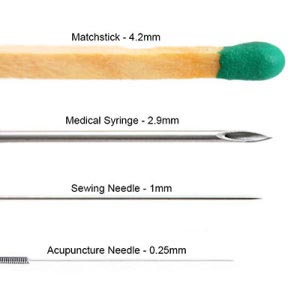 Acupuncture needles range from 0.12mm to 0.30mm gauge with 0.25mm being the gauge I use most frequently. The picture shows a medical syringe to be 2.9mm in gauge which is approximately ten times larger than the average acupuncture needle. I use single use, sterile and disposable needles. I adhere to the BAcC Code of Professional Conduct and The Code of Safe Practice.
Does it hurt?
Sometimes when the Qi of the body grasps the acupuncture needle a dull, achy or mild electrical sensation may be felt. If there is a blockage in the channel you may feel a sensation for a few moments. If an area has been starved of adequate Qi and Blood supply for some time it may temporarily feel uncomfortable as the Qi and Blood begin to flow more freely.
What happens in a session?
During our first meeting I will take an in-depth case history. I will take your pulses, observe your tongue and may use palpation and other examinations depending on your complaint/s. Treatment often involves a combination of retained needles, cupping, moxibustion, and guasha depending on the patient.
How many treatments will I need?
This will depend on you and your symptoms. Everyone is unique and responds to treatment differently. In some cases of chronic illness treatment may take longer and this will also be influenced by other factors such as frequency of treatment and whether lifestyle and dietary changes are adopted.
As a very general guide, for each year you have had your illness, allow 1 month of treatment. I recommend booking 3 weekly consecutive treatments initially as this will enable me to understand how you respond and to resolve any uncertainties in my diagnosis.
In the same way that a GP may send you for further investigations over weeks or months to inform their diagnosis and subsequent treatment, I will monitor carefully how you respond to each treatment to enable a better understanding of how to treat you. In the longer term, patients come for twice weekly, weekly, monthly or seasonal maintenance treatments depending on my diagnosis and their needs.
We will work together at all stages of treatment and regularly revise your treatment plan to best suit your needs. If at any point I feel that the treatment is not working for you, or that I do not have the specific skills to assist you, I will not hesitate in discussing this with you and may refer you to another practitioner with a skill set more beneficial to you.
If acupuncture works why isn't it used in hospitals or prescribed by my doctor in the UK?
The supression of natural medicine in the West goes back a long way. The Flexner report of 1910 commisioned by Andrew Carnegie’s Foundation and funded by The Rockefeller Foundation promoted standardisation of healthcare training and led to the closure of independent naturopathic and traditional medical schools. Huge amounts of financial support were provided for allopathic schools and the modern medical industry. Rockefeller saw the opportunity to monopolise multiple industries all at once; petrol, chemical and medical. Smear campaigns against competitors, and control of the media and Big Pharma has led to demonization of or cynicism towards traditional medicine over the years. This mindset is still strong in the West and little is understood about traditional or alternative medical systems within the mainstream health services.
What is the difference between dry needling and acupuncture?
Dry needling is taught on short courses ranging from a weekend to a few weeks training. Osteopaths, chiropractors, doctors, masseurs and physiotherapists use it as an add on to their existing therapy. It is mostly used in the treatment of musculoskeletal pain and is used in the context of western science to both diagnose and explain the effects produced. For example, “acupuncture works by stimulating sensory nerves”.
Acupuncturists who study acupuncture at degree level for a minimum of 3.5 years use Chinese medical theory to diagnose and treat a huge variety of conditions. Western medical theory and terminology is not used to diagnose or explain the effects of treatment.(On occasion western terms may be used for ease of patient understanding). It is a system unrelated to Western medical thought or practice. A minimum of 10 months is spent from the 3rd year of training in the student clinic, treating members of the public under the guidance of experienced clinical supervisors, prior to qualifying. Most acupuncturists trained in this way continue their education beyond 3.5 years to include post graduate diplomas and continued professional development training and specialities.
Is there any thing I need to do in preparation for my treatment?
It is advisable to eat something prior to coming for treatment, ideally about an hour or two before. Avoid brushing your tongue, as this makes tongue diagnosis unreliable. Please wear loose fitting clothes; most commonly used acu points are located below knees and elbows and on the abdomen. Please bring drinking water with you, a copy of the signed consent form, (if you haven’t returned it to me by email) and a list of any medications you are taking.